
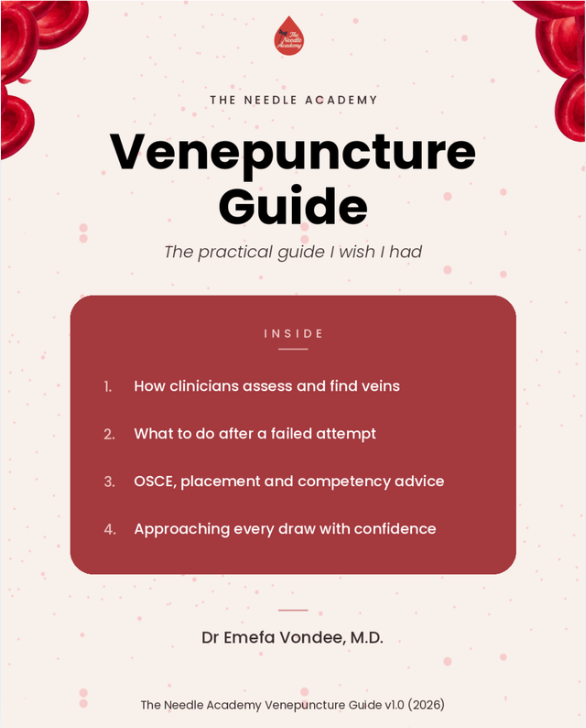
The Needle Academy Venepuncture Guide
The practical guide I wish I had — what to actually do when the draw doesn't go to plan.
- Format
- PDF · A4, print-ready
- Length
- 14 pages, 8 sections
- Author
- Dr Emefa Vondee, M.D.
- Edition
- v1.0 (2026)
- Referenced to
- WHO · CLSI PRE02QG
- Best for
- Students, HCAs, newly qualified
Clinical disclaimer: an educational resource. It does not replace formal clinical training, competency assessment, manufacturer instructions or local policy. Digital purchases are non-refundable once the file has been supplied or accessed, except where the law requires otherwise.
See the real pages before you buy.
Every page below is from the actual guide. Swipe through, then decide.


What's in the 14 pages.
Quick anatomy
The three go-to veins, why the median cubital usually wins, and the variations you will actually meet.
Equipment checklist
Everything laid out before the tourniquet goes on — because fumbling mid-procedure is what trips beginners up.
Needle gauges and colours
Butterfly vs straight, 21G vs 23G, and which to reach for on a small hand vein.
Order of draw
The full tube sequence with inversion counts, and what each bottle is actually for.
What if things don't go to plan?
Rolling veins, no flashback, blood that stops, collapsed veins — with the exact next step for each.
Complications
Haematoma, vasovagal, nerve pain, infection, needlestick — what to do and when to escalate.
Your checklist
A one-page pre-procedure tick list to run before every draw.
References and further reading
WHO drawing-blood guidelines, CLSI PRE02QG and NHS Resolution.
How do I get the guide after I buy it?
The download link lands in your inbox the moment payment clears, and it's also on your order confirmation page. No waiting, no postage.
Is it aligned to UK practice?
It's written by a UK doctor and referenced to WHO's Guidelines on Drawing Blood, CLSI PRE02QG and NHS Resolution guidance on needlestick injuries. Tube colours and order-of-draw protocols vary between labs, so it tells you to follow local policy where they differ.
Who is it for?
Student nurses, medical students, healthcare assistants, phlebotomy trainees, physician associates, and anyone newly signed off who wants a reference for the awkward moments.
Can I print it?
Yes. It's a standard PDF, sized to print at home or read on a phone screen between patients.
Can I get a refund?
Digital purchases are non-refundable once the file has been supplied or accessed, except where the law requires otherwise. If something's wrong with your download, message us and we'll sort it.
Does it replace formal training?
No — and it says so on page 1. It's an educational resource that sits alongside your competency assessment and local policy, not instead of them.